| dc.contributor.author | Alaçamlı, Göksü | |
| dc.contributor.author | Kaşıkçı, Murat | |
| dc.date.accessioned | 2026-06-25T12:02:59Z | |
| dc.date.available | 2026-06-25T12:02:59Z | |
| dc.date.issued | 2026 | en_US |
| dc.identifier.citation | Alacamlı, G., Ozer, O. & Kasıkcı, M. Improvement of dynamic pupillary function after cataract surgery in eyes with pseudoexfoliation syndrome: a six-month longitudinal pupillometry study. Doc Ophthalmol (2026). https://doi.org/10.1007/s10633-026-10121-x | en_US |
| dc.identifier.uri | https://doi.org/10.1007/s10633-026-10121-x | |
| dc.identifier.uri | https://hdl.handle.net/20.500.12809/11228 | |
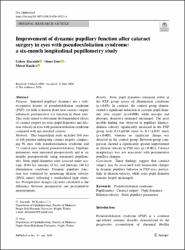
| dc.description.abstract | Purpose Impaired pupillary dynamics are a well-recognized feature of pseudoexfoliation syndrome (PXF), yet little is known about how cataract surgery influences postoperative iris function in these eyes. This study aimed to determine the longitudinal effects of cataract surgery on static pupil diameters and dilation velocity in eyes with pseudoexfoliation syndrome compared with age-matched controls. Methods This longitudinal study included 166 eyes of 166 patients undergoing cataract surgery, comprising 91 eyes with pseudoexfoliation syndrome and 75 control eyes without pseudoexfoliation. Pupillary parameters were measured preoperatively and at six months postoperatively using automated pupillometry. Static pupil diameters were assessed under scotopic (0.04 lx), mesopic (4 lx), and photopic (40 lx) illumination conditions. Dynamic pupillary function was evaluated by measuring dilation velocity (DVel, mm/s) following a standardized light stimulus. Postoperative changes (Delta) were calculated as the difference between preoperative and postoperative measurements. Results Static pupil diameters remained stable in the PXF group across all illumination conditions (p > 0.05). In contrast, the control group demonstrated a significant reduction in scotopic pupil diameter after surgery (p = 0.008), while mesopic and photopic diameters remained unchanged. The most notable finding was observed in pupillary kinetics: dilation velocity significantly increased in the PXF group from 0.13 +/- 0.04 mm/s to 0.17 +/- 0.05 mm/s (p < 0.001), whereas no significant change was detected in the control group. Between-group comparison showed a significantly greater improvement in dilation velocity in PXF eyes (p < 0.001). Cataract morphology was not associated with postoperative pupillary changes. Conclusion These findings suggest that cataract surgery may be associated with measurable changes in dynamic pupillary behavior in PXF eyes, particularly in dilation velocity, while static pupil diameter remains largely unchanged. | en_US |
| dc.language.iso | eng | en_US |
| dc.publisher | Springer Nature Link | en_US |
| dc.relation.isversionof | 10.1007/s10633-026-10121-x | en_US |
| dc.rights | info:eu-repo/semantics/openAccess | en_US |
| dc.subject | Pseudoexfoliation syndrome | en_US |
| dc.subject | Pupillometry | en_US |
| dc.subject | Cataract surgery | en_US |
| dc.subject | Pupil dynamics | en_US |
| dc.subject | Dilation velocity | en_US |
| dc.subject | Static pupillary parameters | en_US |
| dc.title | Improvement of dynamic pupillary function after cataract surgery in eyes with pseudoexfoliation syndrome: a six-month longitudinal pupillometry study | en_US |
| dc.type | article | en_US |
| dc.contributor.department | MÜ, Tıp Fakültesi, Cerrahi Tıp Bilimleri Bölümü | en_US |
| dc.contributor.authorID | 0000-0001-5013-9981 | en_US |
| dc.contributor.authorID | 0000-0002-2748-9702 | en_US |
| dc.contributor.institutionauthor | Alaçamlı, Göksü | |
| dc.contributor.institutionauthor | Kaşıkçı, Murat | |
| dc.relation.journal | DOCUMENTA OPHTHALMOLOGICA | en_US |
| dc.relation.publicationcategory | Makale - Uluslararası Hakemli Dergi - Kurum Öğretim Elemanı | en_US |